
A Simple Guide to Finding Your Home’s Most Essential Systems

Main Water Shutoff Valve
The main water shutoff is a critical valve; in an emergency, you may need to turn it off quickly to prevent flooding. You usually find it where the main water line enters the house, says HVAC and plumbing expert Jordan Benjamin.
“Look along exterior walls, in the garage, or underground near the street in a covered meter box,” says Benjamin. In warm areas, this valve is often outside, but in colder climates, it’s usually in a protected place, such as a basement or utility closet.
The valve itself may have a round handle that you have to turn several times to stop the water, but in newer buildings, it often has a flat handle that you only need to turn 90 degrees.

Main Gas Valve
The main gas valve is even more critical than the water valve, and quick access to it whenever you smell gas can make the difference between a catastrophic explosion and a disaster averted. It’s typically located near the gas meter, says Benjamin. That’s usually outside, nestled up against the foundation, or in the basement. If your home doesn’t have a basement, and you can’t find the meter outside, look in a utility closet, in the crawlspace or under a stairwell.

Electrical Panel
The electrical panel is another one of those parts of a home that lasts for life, and in a modern home, it should be easy to find. Code requires it to be clearly visible, free of obstructions and easy to access. It may be on an exterior wall, in the basement or in a utility closet. If you’re having trouble finding it, note where the utility wires meet the roof and follow them along the wall until they reach the meter. Skip this step if you can already see the meter. The panel is either adjacent to the meter or on the opposite side of the wall. Wire is expensive, and electricians like to use as little as possible when connecting the meter to the panel, so they’re almost always close to each other.

HVAC System
The location of HVAC components depends on the type of heating and cooling systems in the house.
Gas and electric furnaces are usually in the basement or in a dedicated closet, but they could be in the crawl space or attic. If you’re having trouble finding yours, try cranking the thermostat up all the way to turn it on, then quietly walk around the house listening for the hum of the blower motor.
Central A/C units and heat pumps have two components: an indoor air handler and an outdoor condenser. The condenser is big and somewhat noisy, so it’s easy to spot sitting on a concrete pad next to the foundation (or sometimes on the roof). The air handler is often in the basement or a closet, but like a furnace, it could be in a crawlspace or in the attic.
If you have a mini-split system, there’s a condenser unit outside, and the wall units blowing cool or warm air into the house are the air handlers.

Water Heater
Water heaters can potentially be products that last for life, but 10 to 15 years is more typical. If you have a gas water heater, you definitely need to know where it is, so you can relight it if the pilot goes out. A tank-style water heater usually finds a home in the basement, the garage or a utility closet. A tank full of water is heavy, so it’s rare to find one on an upper story. On-demand water heaters are much smaller and, because they hang on the wall, they can be harder to spot. They’re often in basements, garages and utility closets.
- Pro tip: Once you know the location of your water heater, you can find your main water shutoff by tracing back the cold water inlet pipe.

Cooking Stuff
Aranda has this advice for organizing your cooking utensils. “In every kitchen, I organize using zone-based storage, meaning items reside based on usage patterns rather than availability.” The most used bowls, utensils, pots and pans, she says, should be most accessible. If you organize your kitchen this way, you’ll find it easier to locate, for example, the party-sized salad bowl you need for the big party tomorrow. It should be in the back of the cabinet, behind the bowls you use more frequently, or on an upper or lower shelf.
Bedding
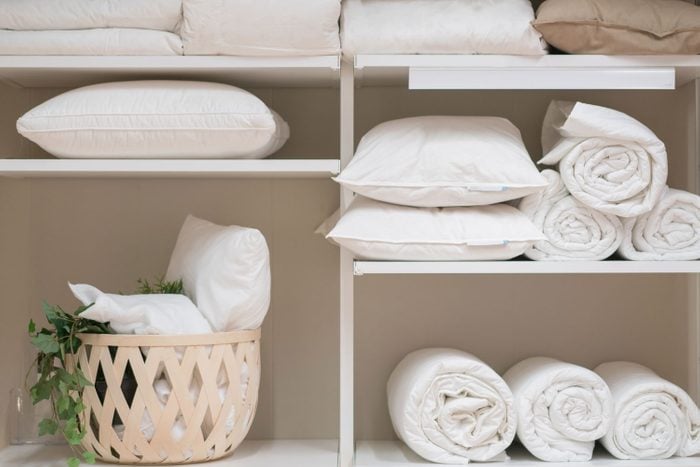
Bedding storage should adhere to the same rules as kitchen storage, says Aranda, with the bedding sets currently being used being the most accessible. “Each bed’s set resides on its own shelf or designated area within the linen closet, identified so that any adult in the household can independently make their own bed without having to ask where any pieces are.”
What about seasonal duvets and extra bedding? Put them on upper shelves or under the beds if extra space isn’t available. “The rule is that currently used items must be immediately accessible — infrequently needed items require additional effort.”

Tools
Aranda identifies tools and home maintenance supplies as the category households manage worst. “All tools should live in one single dedicated location that every person living in your residence knows about,” she says. She calls this “tool central,” and it’s where you go to access your basic toolkit as well as maintenance supplies like light bulbs, batteries and small hardware. It’s also where your stepladder should be, so you don’t have to search for it in the middle of the night when a smoke alarm starts beeping.
Where is the best place for “tool central?” It can be in a closet, the basement or the garage. The most important thing, according to Aranda, is to tell everyone living in the household where it is. It’s also important to be consistent about putting everything you take from there back again.
About the Experts
- Jordan Benjamin is an HVAC and plumbing expert and the President of Done Rite Services, an HVAC, Plumbing and Electrical company in Tucson, Arizona. He has over two decades in the HVAC trade
- Isabella Flores is a cleaning expert and professional organizer associated with Sparkly Maid San Diego.
The post A Simple Guide to Finding Your Home’s Most Essential Systems appeared first on Family Handyman.
For top-notch cleaning services, look no further than mj cleaning services, where quality and customer satisfaction are our top priorities. Whether you're in need of a one-time cleaning or ongoing maintenance, m j cleaning services offers a wide range of options to suit your requirements. With a reputation for excellence, m.j. cleaning services delivers professional and reliable cleaning solutions to ensure your home or office stays pristine and welcoming.


No comments